What Is Headless Commerce? A Practical Guide for Modern Ecommerce Teams

Table of Contents
In e-commerce, speed isn't just important; it's everything. A single second of page load delay can slash mobile conversions by 20%, while sites loading within two seconds see conversion rates jump by 15%. This performance gap is costing businesses real revenue every day.
Headless commerce solves this critical challenge by decoupling the customer-facing frontend from backend systems, enabling businesses to build faster, more adaptable digital stores. The market validates this shift: headless commerce platforms reached $3.5 billion in 2025 and are projected to hit $7 billion by 2028. Companies adopting this architecture reduce digital experience launch times by 40-50%, while omnichannel customers deliver 30% more lifetime value than single-channel shoppers.
This guide explores how headless commerce enables businesses to deliver fast, consistent experiences across every touchpoint, mobile apps, web stores, social commerce, and IoT devices, through API-connected architecture. You'll discover what headless commerce is, how it works, and why it's becoming essential for competitive ecommerce in 2025 and beyond.
What Is Headless Commerce?
Headless commerce separates the customer-facing frontend (the "head") from backend functionality and business logic. Coined by Commercetools co-founder Dirk Hoerig in 2013, this architectural approach emerged from Forrester Research recommendations to "loosely" couple ecommerce store layers.
Traditional platforms tightly integrate all layers into a single system. Headless commerce creates independent systems that communicate through APIs (Application Programming Interfaces), enabling seamless data and functionality flow between your storefront and business operations without creating dependencies.
The term "headless" refers to removing the presentation layer "head" from the backend "body." This separation enables custom experiences across multiple platforms—websites, mobile apps, voice assistants, IoT devices, and emerging technologies like augmented reality.
How Headless Commerce Works?
Headless commerce architecture operates by separating the presentation layer from business logic, allowing components to function independently while maintaining API connectivity.
The Foundation: API Communication
RESTful or GraphQL APIs enable seamless data exchange between layers. When a customer clicks a product, the frontend sends an API request to the backend, which processes it and returns formatted data (typically JSON or XML). This flexibility ensures frontend modifications never disrupt backend operations.
Essential Architecture Components
Commerce Engine (Backend): Manages all transactional logic including products, shopping carts, and checkout functionality.
API Gateway Layer: Handles authentication, authorization, and request validation to ensure secure communication.
Frontend Clients: Various customer-facing interfaces consuming the same backend APIs for consistent experiences.
Supporting Services Complementary systems like CMS (Content Management System), PIM (Product Information Management), and OMS (Order Management System).
Scaling with Microservices
As businesses grow, many evolve toward domain-specific microservices, breaking monolithic systems into specialized services for catalogs, pricing, inventory, and orders. Each service maintains its own data store and communicates through event systems like Kafka or RabbitMQ.
This architecture enables businesses to power multiple touchpoints simultaneously without duplicating logic, providing technical freedom for rapid iteration and innovation.
Key Benefits of Headless Commerce
Companies implementing headless commerce consistently outperform traditional approaches. Salesforce reports that 81% of companies with this architecture modify their ecommerce websites faster, while 83% achieve superior digital experience customization.
Faster Feature Deployment Teams update frontend systems independently of backend operations, dramatically reducing time to market for new features and improvements.
Superior Scalability Frontend and backend systems scale independently, proving invaluable during high-traffic periods like seasonal sales or promotional events.
Enhanced Performance Optimized architecture delivers measurable speed improvements. Since a 1-second delay drops mobile conversions by 20%, performance gains directly impact revenue.
Seamless Omnichannel Experiences Deliver personalized content consistently across websites, mobile apps, and physical stores. This unified approach drives 75% higher incremental store visits.
Future-Ready Flexibility Adapt to emerging technologies without overhauling backend systems. This adaptability helps 80% of companies maintain competitive advantage through best-of-breed integrations.
Headless commerce represents a strategic investment that extends far beyond technical upgrades, fundamentally transforming how businesses engage customers across channels.
Headless Commerce vs Traditional Ecommerce
The fundamental difference lies in architecture. Traditional (monolithic) platforms bundle frontend and backend into a single, interdependent system. Headless commerce separates these layers, connecting them through APIs.
The Hybrid Trend
Market data reveals 92% of companies using full-stack commerce platforms are transitioning to blended SaaS commerce platforms. This shift demonstrates businesses don't face an either-or decision,hybrid approaches deliver both flexibility and simplicity based on specific organizational needs and maturity levels.
Headless Commerce for Enterprise and B2B Brands
Enterprise and B2B brands face uniquely complex digital commerce challenges that traditional platforms simply cannot address effectively: rigid legacy architecture accumulated over decades, intricate multi-step buying processes involving multiple stakeholders, and rapidly evolving customer expectations that consistently outpace traditional platform capabilities.
For these organizations, headless commerce has evolved from an interesting technical option to an absolute competitive necessity for market survival.

Enterprise-Specific Advantages
Extensive Customization Capabilities: Create completely tailored interfaces for different customer segments, geographic markets, or business divisions, each with unique requirements, workflows, and preferences. Support distinct user experiences for wholesale buyers, retail partners, and direct consumers, all powered by the same commerce backend.
Independent Scalability: Effectively manage unexpected traffic spikes during product launches, promotional campaigns, or peak business periods without system-wide performance degradation that frustrates customers and damages brand reputation. Scale resources precisely where needed without over-provisioning entire infrastructure.
Seamless Enterprise Integration: Connect naturally with mission-critical core enterprise systems like ERP (Enterprise Resource Planning), CRM (Customer Relationship Management), and PIM (Product Information Management) platforms for unified, real-time data flow. Eliminate data silos and manual synchronization processes that create errors and operational inefficiencies.
Advanced B2B Features: Effortlessly support complex requirements like customer-specific product catalogs, individually negotiated pricing structures, multi-level approval workflows, and sophisticated role-based permissions. These capabilities prove extremely difficult for traditional monolithic platforms to accommodate without extensive, expensive customization.
How to Get Started with Headless Commerce
Successful headless commerce adoption requires careful strategic planning combined with the right technical expertise. The choice between complete platform replacement and gradual migration significantly impacts both timelines and outcomes, making a phased approach the preferred strategy for most organizations.
The Phased Implementation Approach
Minimize business disruption, control costs, and enable smooth team adaptation through incremental, strategic adoption. Begin with high-impact, lower-risk areas like product listing pages or checkout flow optimization, then systematically expand to additional touchpoints. Monitor key performance metrics after each launch phase to incorporate valuable learnings and refine your approach for subsequent iterations.
Implementation Steps
1. Define Specific Business Goals Clearly identify what you want to achieve through headless architecture: page load speed optimization for better conversions, advanced personalization capabilities for targeted experiences, or expanded omnichannel reach across new customer touchpoints. Establish measurable success criteria before beginning technical work.
2. Assess Available Resources Honestly evaluate whether you have adequate developer expertise internally with API integration experience and modern frontend framework knowledge, or if you need to engage specialized agency partners to ensure successful implementation and ongoing optimization.
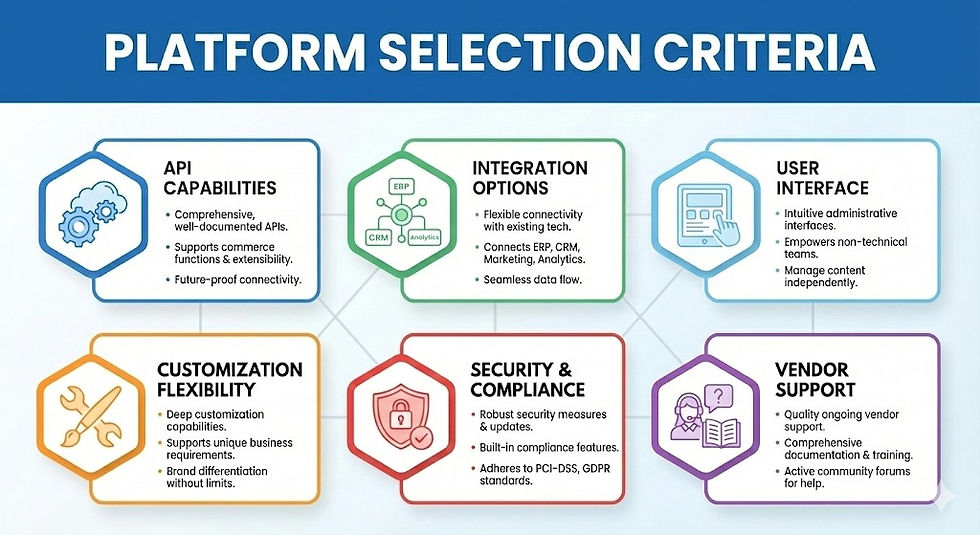
3. Choose Backend Commerce Platform Select an API-first commerce solution that aligns with your specific business requirements, existing technology ecosystem, scalability needs, and budget constraints. Prioritize platforms with robust API documentation, proven enterprise reliability, and active developer communities.
4. Select Frontend Tools and Framework Make informed decisions about CMS, DXP (Digital Experience Platform), or development framework options based on your team's expertise and project requirements. Popular choices include WordPress for content-heavy sites, Contentful for enterprise content management, or Next.js for highly customized React-based experiences.
5. Start with Proof of Concept Launch a contained, lower-risk project like a custom campaign landing page, seasonal microsite, or content-focused storefront section. This validates your architectural approach, builds team confidence and technical expertise, and demonstrates tangible value to stakeholders before larger infrastructure investments.
Conclusion
Headless commerce transforms digital storefronts by separating customer-facing elements from backend systems, delivering flexibility and performance that traditional platforms cannot match. Success requires strategic planning and phased implementation, starting with high-impact areas before expanding systematically.
This approach builds team expertise, measures outcomes, and refines strategies with each iteration. Modern customers expect seamless experiences across every channel, and headless commerce delivers fast, consistent interactions across mobile apps, websites, voice assistants, and emerging technologies.
Partner with Trika Technologies to transform your digital commerce architecture and deliver exceptional customer experiences across every touchpoint. Your business deserves technology as adaptable and forward-thinking as your growth vision, and the question isn't whether to adopt headless commerce, but how quickly you can implement it to maintain competitive advantage.
Frequently Asked Questions
Q1. What is headless commerce and how does it differ from traditional ecommerce?
Headless commerce separates the frontend presentation layer from backend functionality using APIs to connect independent systems. Traditional ecommerce tightly integrates these components into a single platform, limiting flexibility and customization options.
Q2. What are the main benefits of implementing headless commerce?
Key benefits include dramatically improved website speed, enhanced customization flexibility, superior omnichannel experiences, independent scalability, and rapid adaptation to new technologies without backend overhauls.
Q3. Is headless commerce suitable for all businesses?
Headless commerce particularly benefits larger enterprises and B2B brands with substantial online revenue (typically $50-100+ million). Smaller businesses with limited technical resources may find traditional platforms more cost-effective and manageable.
Q4. How does headless commerce improve customer experience?
Headless architecture enables faster page loads, consistent experiences across multiple touchpoints, and advanced personalization capabilities, resulting in improved customer satisfaction and higher conversion rates.
Q5. What should businesses consider before implementing headless commerce?
Define specific goals, assess available resources and technical capabilities, choose appropriate backend and frontend solutions, and start with a proof of concept. A phased implementation approach minimizes risks and costs while enabling gradual team adaptation.

Comments