What Is VTEX? The Complete Guide to Unified B2B and B2C Commerce
Updated: Jan 2

Table of Contents
Commerce shouldn't be complicated, yet 76% of consumers abandon purchases when platforms fail to deliver seamless experiences. The culprit? Fragmented systems where B2B runs on one platform, B2C on another, and inventory management lives somewhere else entirely. Meanwhile, businesses that unify their operations see transformative results: Grupo Exito achieved a 22.4% revenue increase, while Mazda Motor Europe reached over 75% conversion from reservation to sales.
VTEX delivers the solution through pragmatic, composable architecture, combining marketplace capabilities, order management, and flexible microservices in one unified platform. This guide explores what VTEX is, how its composable architecture works, and why unified commerce platforms are essential for competitive advantage.
What Is VTEX?
VTEX is a microservices-based commerce platform that unifies B2B and B2C operations through composable architecture. Founded in 2000, the platform serves 2,700 clients across 43 countries, including Coca-Cola, Sony, Walmart, and Nestlé. Unlike traditional platforms that promise integration but deliver complexity, VTEX combines three core capabilities: marketplace functionality, native order management, and composable commerce architecture in a single, auto-scaling SaaS solution.
Gartner recognizes VTEX as a Challenger in their Magic Quadrant for Digital Commerce 2025, while Paradigm B2B reports position VTEX as a strong performer earning 20+ medals across all categories.
How VTEX's Composable Architecture Works
Traditional monolithic platforms trap businesses in rigid structures where changing one component risks breaking others. VTEX's composable architecture eliminates these constraints by separating functionality into independent, API-connected microservices. Each component operates, updates, and scales separately without disrupting other systems.
The Foundation: Pragmatic Composability
VTEX implements "Pragmatic Composability," balancing flexibility with operational reality. Rather than forcing complete platform rebuilds, VTEX provides a foundation that evolves through four distinct composability levels:
Native Features Start with built-in functionality for fastest time-to-market and immediate business value.
Selective Integration Progress to best-of-breed third-party solutions as specific requirements emerge.
Advanced Customization Scale to maximum flexibility when business demands warrant deeper technical investment.
Full Composability Access complete architectural freedom for unique enterprise requirements while maintaining stability.
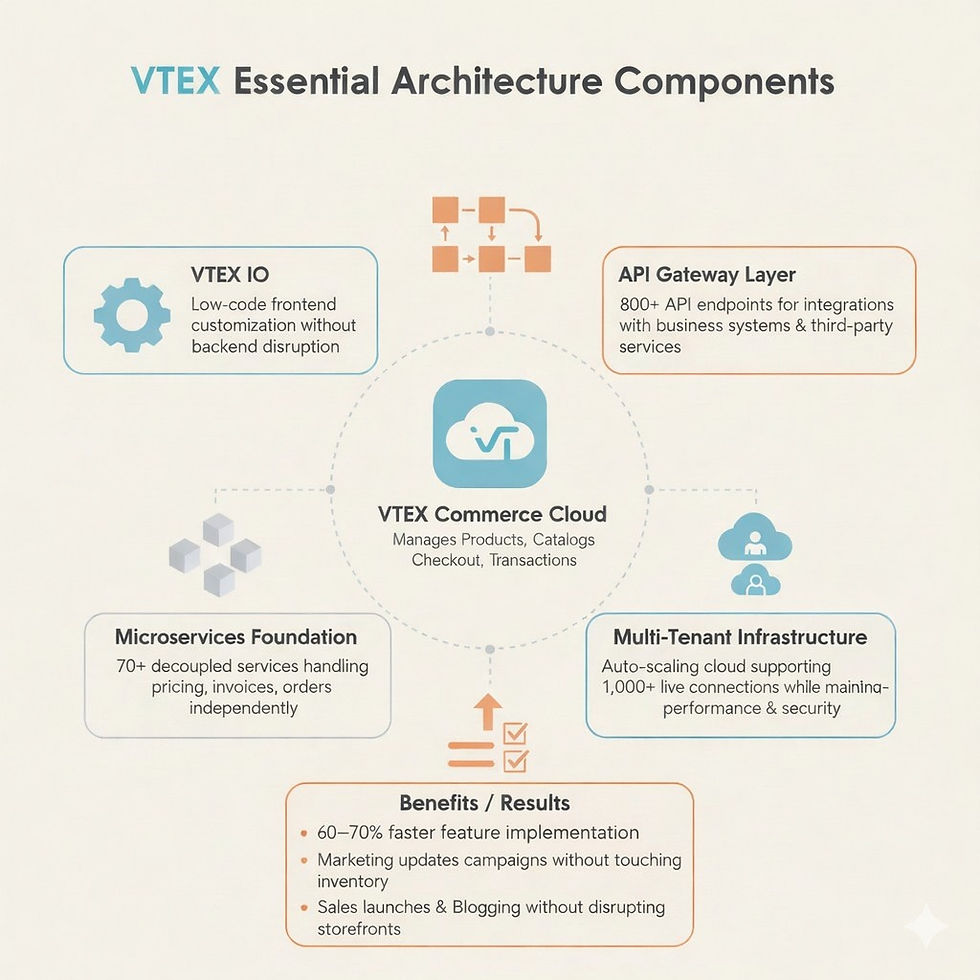
Essential Architecture Components
Commerce Cloud The core platform managing products, catalogs, checkout, and transactional logic across all channels.
VTEX IO Low-code development environment enabling rapid frontend customization without backend disruption.
API Gateway Layer 800+ API endpoints facilitating seamless integrations with existing business systems and third-party services.
Microservices Foundation 70+ decoupled services handling specialized functions like pricing, inventory, promotions, and order orchestration independently.
Multi-Tenant Infrastructure Auto-scaling cloud architecture supporting 1,000+ live system connections while maintaining performance and security.
This architecture delivers 60-70% faster implementation of new features compared to traditional platforms. Marketing updates campaigns without touching inventory systems. Sales launches new B2B pricing without disrupting customer storefronts.
Key Benefits of VTEX's Unified Commerce
Companies implementing VTEX consistently outperform fragmented platform approaches. The architecture delivers measurable advantages across operations, customer experience, and business agility.
Unified B2B and B2C Operations: Manage both business models on a single platform without duplicating infrastructure, teams, or processes. Handle complex B2B requirements like custom pricing structures and multi-level approval workflows alongside streamlined B2C experiences.
Independent Component Scaling: Scale frontend and backend systems separately based on actual demand. Traffic spikes during promotions impact only loaded components, not entire platforms, dramatically reducing infrastructure costs while maintaining performance.
Accelerated Feature Deployment: Teams update and deploy features independently without coordinating across multiple vendors or risking system-wide disruptions. Reduce time-to-market by 60-70% compared to monolithic platforms.
Enhanced Customer Experience: Deliver consistent, personalized experiences across all touchpoints: websites, mobile apps, physical stores, and emerging channels. Since 76% of consumers abandon poor experiences, performance directly impacts revenue.
Operational Cost Reduction: Eliminate redundant systems, consolidate vendor relationships, and reduce technical debt. Teams focus on strategic initiatives instead of managing integrations between disconnected platforms.
Future-Ready Flexibility: Adapt to emerging technologies and market changes without overhauling core systems. Add new sales channels, integrate innovative services, or pivot business models while maintaining operational continuity.
VTEX vs Traditional Commerce Platforms
The fundamental difference between VTEX and traditional platforms lies in architectural approach. Traditional solutions force businesses to choose between integration simplicity and operational flexibility. VTEX eliminates this false choice.
Industry data reveals nearly half of IT teams have already adopted composable commerce, with another 43% planning implementation. This momentum reflects measured business outcomes, not speculative trends.

Implementation Best Practices for VTEX
Platform selection matters less than execution strategy. Most enterprise implementations fail due to rushed planning rather than technology limitations.
Define Your Minimum Viable Product
Identify essential functionalities, critical pages, and information architecture that deliver immediate business value at launch. MVP definition prioritizes elements driving measurable outcomes before expanding scope.
Create Detailed Implementation Roadmaps
Develop comprehensive plans at least 15 days before go-live, outlining specific actions, clear accountabilities, and firm deadlines. Schedule regular alignment meetings while establishing dedicated "war rooms" for addressing last-minute issues.
Implement Comprehensive Testing Protocols
Soft Launch Testing Deploy with restricted market access before full release to identify issues under controlled conditions.
Quality Assurance Validation Test every store element systematically to ensure technical functionality meets specifications.
User Acceptance Testing Confirm platform meets MVP requirements from actual user perspectives and business workflows.
Prioritize Security Throughout Implementation
Grant minimal necessary permissions and regularly evaluate user roles. Control app key permissions restrictively and limit admin access to corporate domains. Enable two-factor authentication as standard practice across all user levels.
Manage Development Workspaces Effectively
Never develop directly in production environments. Use dedicated development workspaces for all application development and maintain efficient code versioning practices to prevent disrupting active stores.
Leverage VTEX Resources and Expertise
VTEX's extensive documentation and partner ecosystem accelerate implementation timelines. The platform provides detailed guidance on go-live preparation, workspace management, and security protocols, eliminating guesswork from critical decisions.
How Trika Technologies Accelerates VTEX Success
Platform power means nothing without the right implementation partner. Most businesses approach migrations as technology projects while overlooking change management, team adoption, and sustained business continuity.
Trika Technologies specializes in VTEX implementations prioritizing business outcomes alongside technical excellence. Their methodology balances implementation speed with thoroughness, assessing existing systems, mapping detailed business requirements, and building roadmaps that maintain operations throughout transition.
Pragmatic Composability Expertise
Trika's certified specialists understand VTEX's four-level composability approach, helping organizations start with appropriate complexity levels and evolve as requirements mature. This prevents both under-engineering that limits capabilities and over-engineering that wastes resources.
Knowledge Transfer and Team Empowerment
Beyond technical implementation, Trika transfers knowledge systematically, empowers internal teams, and builds lasting organizational capabilities. This approach ensures your business owns its success rather than depending on external support indefinitely.
Ongoing Optimization Services
Partnership extends beyond go-live through continuous platform enhancements, strategic guidance, and technical support scaling with your growth. This sustained engagement maximizes ROI while adapting to evolving business requirements.
Partner with Trika Technologies to unlock VTEX's full potential and accelerate your commerce transformation with confidence.
Conclusion
Businesses choosing unified platforms over fragmented systems unlock growth that seemed impossible under traditional constraints. VTEX's pragmatic composable architecture delivers what enterprise leaders need: the ability to start simply and evolve sophisticated capabilities, with companies achieving measurable improvements like 22.4% revenue increases and 75% conversion rate improvements.
Partner with Trika Technologies to unify your commerce operations and build sustainable competitive advantage. The question isn't whether unified commerce delivers value but how quickly you can implement it to capture opportunity.
Frequently Asked Questions
Q1. What makes VTEX different from other ecommerce platforms?
VTEX unifies comprehensive marketplace capabilities, native order management, and composable architecture in a single platform. Unlike competitors treating these as separate products, VTEX integrates all three while maintaining flexibility to customize individual components.
Q2. How does VTEX's composable architecture benefit businesses?
Composable architecture enables 60-70% faster feature implementation compared to traditional platforms. Businesses customize and scale individual components independently, adapting quickly to market changes without system-wide disruption.
Q3. Can VTEX handle both B2B and B2C commerce operations?
Yes, VTEX seamlessly connects B2B and B2C operations on a unified platform. It addresses complex B2B requirements like multi-level approvals and custom pricing structures while simultaneously supporting streamlined B2C experiences without duplicating infrastructure.
Q4. What results have businesses achieved after implementing VTEX?
Companies report significant measurable improvements. Grupo Exito experienced 22.4% revenue increase after implementing VTEX Intelligent Search. Mazda Motor Europe achieved over 75% conversion from reservation to sales.
Q5. How does VTEX ensure scalability during peak demand periods?
VTEX's multi-tenant SaaS architecture auto-scales during peak demand, adjusting infrastructure dynamically based on actual load. Individual components scale independently rather than requiring entire system scaling, reducing costs while maintaining performance.


Comments