What is E-commerce Search Optimisation for Enterprise Commerce?

Table of Contents -
E-commerce search optimisation decides whether demand converts or disappears. Buyers arrive with intent, type a query, and expect a precise match. When the system fails to return it, the session ends. The traffic spend is already sunk.
In B2B ecommerce, this is not a usability issue. Buyers search for exact SKUs, specifications, or repeat orders. They are not browsing. If the system cannot surface the right product immediately, they move on.
Most search failures are not caused by missing products. They come from how queries are interpreted, how product data is structured, and how results are ranked. The system returns something, but not what the buyer needs. That gap is where conversion drops. This guide breaks down how e-commerce search systems actually work, where they fail under real conditions, and what it takes to keep them aligned with buyer intent at scale.
What Is E-Commerce Search Optimisation?
E-commerce search optimisation decides whether a query turns into a result that can be bought. A buyer types something specific. The system has to translate that input into a ranked set of products pulled from the catalogue. If the mapping is off at any step, the result is either irrelevant or unusable.
At a system level, search is controlled by three layers: how the query is interpreted, how product data is indexed, and how results are ranked. These are not independent. A failure in any one of them breaks the outcome.
In B2B environments, the margin for error is narrow. Queries include part numbers, specifications, and compliance requirements. The system is not guessing intent. It is matching exact conditions against structured data. Search does not operate in isolation. It depends on how product data flows from ERP, PIM, and catalogue systems into the search index. When those systems are not aligned, search reflects the inconsistency rather than correcting it.
Search breaks when these layers fall out of alignment. The query is valid, but the data does not support it. The product exists, but the ranking does not surface it. The system returns results, but not the ones the buyer is looking for. At scale, this becomes a coordination problem across systems. Indexing delays, inconsistent attributes, and update latency all affect how search behaves under real conditions. When that coordination slips, conversion drops.
Why E-commerce Search Drives Product Discovery?
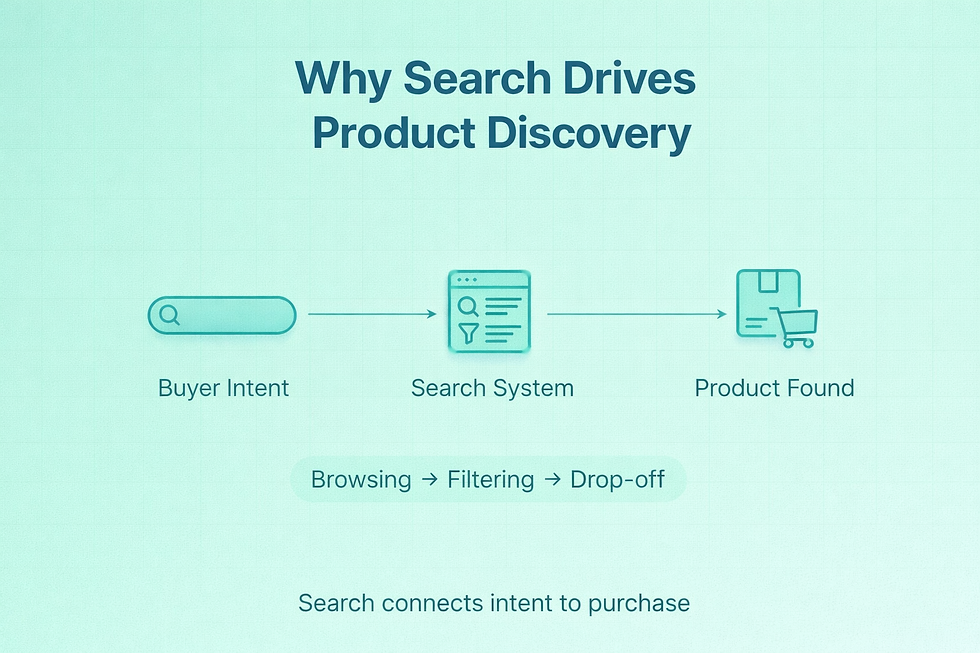
Search is where intent enters the system. Buyers are not navigating categories to explore options. They arrive knowing what they need and expect to retrieve it directly.
In B2B environments, queries are specific. Part numbers, technical specifications, and reorder SKUs. Navigation slows this down. Search compresses it into a single step.
When search works, it reduces the distance between intent and purchase. When it does not, the system forces buyers into fallback behaviour: browsing, filtering, or leaving.
At scale, this is not about convenience. It determines whether product discovery happens at all.
How E-commerce Search Works?
Search is a sequence: query → interpretation → indexed retrieval → ranking.
The output depends on how consistently these steps operate against the same data state.
The query is first normalised. This includes handling abbreviations, part numbers, and structured inputs. In B2B environments, interpretation errors are not minor. A mismatch at this stage prevents retrieval entirely.
The processed query is matched against a search index built from ERP, PIM, and catalogue data. This index is not the source of truth. It is a derived layer optimised for retrieval speed. Any delay or inconsistency in upstream systems is reflected in the index.
Ranking logic then orders the results. It prioritises attribute relevance, availability, and configured business rules. The system does not validate correctness. It ranks what is present in the index.
Product updates, inventory changes, and attribute modifications do not reach the index at the same time. Search operates on one version of the data, while fulfilment systems operate on another. At scale, this gap becomes visible. Queries are processed against the indexed state, while OMS and WMS execute against the current inventory. The system returns results that are valid for the index but not aligned with actual availability.
This is where search and fulfilment diverge. The issue is not relevance alone. It is the timing and consistency of data across systems.
Key Components of E-commerce Search Optimisation
Search fails when query handling, product data, ranking logic, and indexing operate on different data states. Each component must align against the same source of truth, or results degrade in predictable ways.
Query Handling
Structured inputs such as part numbers and specifications must map exactly. Variations in format or naming prevent retrieval entirely, even when the product exists.
Product Data
Gaps between PIM, ERP, and the search index result in products being present in source systems but missing or misrepresented in search.
Ranking Logic
Result ordering can override intent. Availability signals or business rules can push e exact matches below less relevant products, making them effectively invisible.
Indexing
Delays in syncing product and inventory updates create gaps between system state and search results. The system returns what is indexed, not what currently exists.
Search systems reflect how these components interact, not how each performs individually. Aligning all four against a consistent data state is what determines whether search produces usable results at scale.
Where E-commerce Search Fails and How It Impacts Conversion?

Search failures occur across multiple layers, each introducing a mismatch between query intent and product data. The system does not fail in a single step. It fails when query interpretation, data representation, and ranking operate on different assumptions. Each layer can be technically correct on its own, but still produce the wrong outcome when combined.
These failures are not always visible immediately. The system returns results, but not the ones the buyer is looking for. From the outside, the search appears functional. In practice, it is misaligned with how buyers query and how products are structured across systems.
Query interpretation fails to map structured inputs such as part numbers or specifications
Product data is incomplete or inconsistent across systems, so the index does not represent the product correctly
Ranking logic returns results, but orders them incorrectly, pushing the relevant product out of view
These failures compound. A correct query can still fail due to data gaps. Accurate data can still fail due to ranking. From the buyer’s perspective, the outcome remains unchanged. The product is not found.
At scale, the same mismatches repeat across large sections of the catalogue, turning small gaps into consistent conversion loss.
How Search Behaviour Data Improves Optimisation?
Search behaviour data captures how buyers interact with queries and results. It shows where the system is not aligned with how buyers search.
Key Behaviour Signals
These signals indicate where retrieval or ranking is not aligned with intent.
Click patterns on search results
Zero-result queries
Repeated or modified queries
Low interaction with top-ranked results
What These Signals Indicate
Repeated queries suggest the system is not returning usable results on the first attempt. Zero-result queries indicate gaps in indexing or attribute mapping. Low interaction with top results points to ranking issues rather than missing data.
How Systems Use This Data
Behaviour data is used to refine query handling, improve attribute mapping, and adjust ranking logic. It replaces assumptions with observed patterns from actual usage.
At scale, this data becomes the primary input for optimisation, as query patterns change faster than system configuration.
Conclusion
Search fails when query handling, product data, indexing, and ranking operate on different data states. The product exists, but the system cannot return it in a form the buyer can act on.
Each layer can function independently and still produce the wrong outcome when combined. Query interpretation can be correct, but the data is incomplete. Data can be structured, but ranking does not surface the right result. The system returns results, but not the one that matches the intent.
At scale, these gaps do not stay isolated. They repeat across queries, categories, and sessions, turning small inconsistencies into consistent retrieval failure. Search performance depends on maintaining alignment across all layers as data and query patterns change. Systems that maintain this alignment produce predictable results. Systems that do not drift away from how buyers search. Trika Technologies works with retailers to align product data, indexing pipelines, and search systems so that query interpretation, ranking, and inventory state remain consistent as data and query patterns evolve.
Frequently Asked Questions
Q1. How is e-commerce search different from basic site search?
E-commerce search operates on structured product data, attributes, and inventory signals. It must return results that can be purchased, not just relevant content, which requires alignment with the catalogue and fulfilment systems.
Q2. Why do exact product searches still return incorrect results?
Because ranking logic can override exact matches. Availability signals, incomplete attributes, or configured rules can push the correct product below less relevant ones.
Q3. How does indexing affect search accuracy?
Search results depend on the indexed version of product data. If updates from upstream systems are delayed or inconsistent, the index reflects that state rather than the current catalogue.
Q4. Why do search results differ from actual inventory availability?
Search operates on indexed data, while fulfilment systems operate on current inventory. When updates are not synchronised, results and availability diverge.
Q5. What signals indicate search system misalignment?
Repeated queries, zero-result searches, and low interaction with top results indicate gaps in query handling, data mapping, or ranking logic.


Comments