Dynamic Pricing in E-commerce: How Retailers Adjust Prices in Real Time


Table of Contents -
A pricing system in e-commerce receives continuous inputs from multiple sources. Product views increase on one channel, conversion rates change during a campaign window, competitor prices update across marketplaces, and inventory levels vary across fulfillment nodes.
The price shown to the customer depends on how these inputs are processed at that moment. It is not fixed. It is the output of a decision layer reacting to current system conditions.
When pricing is set in advance and held constant, it disconnects from these inputs. Demand may increase in one channel, inventory may tighten in a specific location, and competitor prices may update within minutes, while the price remains unchanged.
This gap affects revenue capture. Industry benchmarks indicate that retailers can lose 5–15% of potential revenue when pricing does not respond to demand and inventory conditions. This guide examines why static pricing fails in modern e-commerce environments and how dynamic pricing systems keep pricing aligned with current system inputs.
What Is Dynamic Pricing in E-commerce?
Dynamic pricing in e-commerce operates as a decision layer connected to multiple systems. It processes inputs such as demand signals, inventory positions, and competitor pricing, and updates prices based on current conditions rather than fixed schedules.
In enterprise environments, this layer integrates with systems like ERP, OMS, and commerce platforms. Pricing is not handled in isolation. It depends on how data flows across these systems and how quickly it is processed.
Key Factors That Influence Dynamic Pricing Decisions
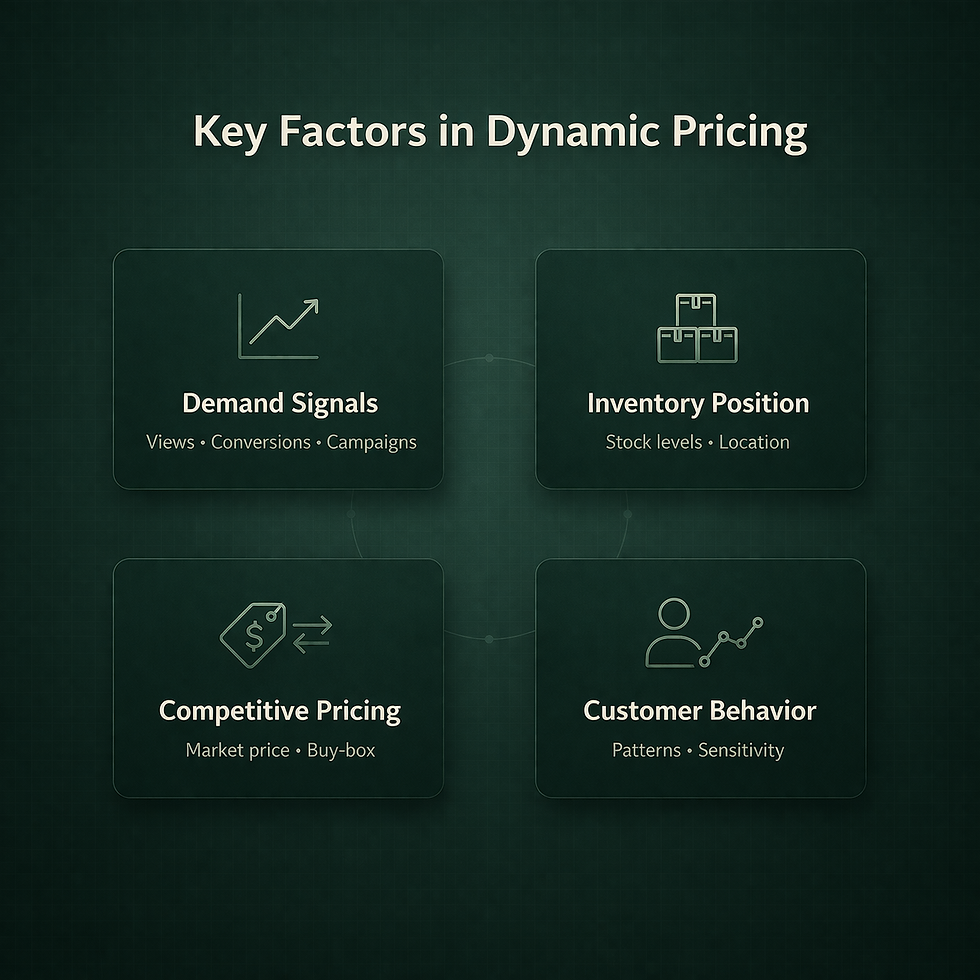
Dynamic pricing decisions are driven by a combination of inputs that reflect current system conditions.
Demand Signals
Demand is measured through activity such as product views, add-to-cart rates, and completed transactions.
Higher conversion rates indicate stronger demand at a given price
Channel-specific demand patterns influence pricing adjustments
Campaign activity can change demand levels within short time windows
Inventory Position
Inventory reflects stock availability across locations and fulfillment nodes.
Excess inventory requires faster sell-through
Limited stock supports higher pricing control
Location-based availability affects pricing decisions across regions
Competitive Pricing
Competitive pricing directly affects visibility and conversion, especially on marketplaces.
Price differences influence ranking and buy-box positions
Competitor prices are tracked continuously
Adjustments are made to remain competitive without uniform reductions
Customer Behavior
Customer behavior adds another layer, particularly in direct channels.
Repeat customers and new users respond differently to pricing
Purchase patterns influence price sensitivity
Behavioral data supports more targeted pricing decisions
These factors operate together. Pricing decisions depend on how demand, inventory, competition, and customer behavior interact at a given point in time.
How Dynamic Pricing Engines Adjust Prices in Real Time?
Dynamic pricing engines adjust prices by processing live inputs and applying pricing logic without waiting for manual intervention. The process depends on how quickly data moves through the system and how consistently updates are applied across channels.
Input → Decision → Execution Flow
The engine receives continuous inputs from demand, inventory, and competitive sources. Product activity, stock changes, and marketplace pricing updates are ingested through APIs and event streams and evaluated as they arrive.
Pricing logic then determines how the system responds:
Demand signals influence whether pricing should move up or down
Inventory levels define constraints based on availability
Competitive pricing affects positioning, especially on marketplaces
The engine calculates a new price based on the combined state of these inputs.
Once calculated, prices are pushed across channels. Updates are applied to websites, apps, and marketplaces to keep pricing aligned with current conditions. In multi-channel environments, synchronization becomes critical to avoid mismatches.
The effectiveness of this process depends on latency and consistency. Delays in data processing or price updates create gaps between system conditions and displayed pricing.
How to Implement Dynamic Pricing in E-commerce Systems?

Implementing dynamic pricing requires a structured rollout across systems rather than an immediate full-scale deployment.
Define Pricing Logic and Constraints
The first step is to establish how pricing should respond to system inputs.
Define rules based on demand, inventory, and competition
Set boundaries for minimum and maximum price limits
Align pricing logic with revenue and margin targets
This creates a controlled foundation before automation.
Integrate Data Sources
Dynamic pricing depends on consistent and accurate inputs.
Connect demand signals from storefronts and marketplaces
Integrate inventory data across warehouses and fulfillment nodes
Ingest competitive pricing where relevant
Data consistency is critical at this stage.
Deploy Pricing Engine Across Channels
Once logic and data are in place, pricing can be applied across channels.
Roll out pricing updates to the website, app, and marketplaces
Ensure synchronization across all touchpoints
Validate that updates reflect the same underlying logic
This ensures pricing remains aligned across the system.
Monitor and Refine
Dynamic pricing requires continuous oversight after deployment.
Track performance against conversion, revenue, and margin metrics
Identify inconsistencies or unexpected pricing behavior
Refine rules and thresholds based on observed outcomes
How Retailers Balance Revenue, Margins, and Pricing Strategy?
Dynamic pricing requires managing trade-offs between revenue, margins, and how pricing is experienced across channels.
Revenue and Margin Control
Pricing adjustments directly influence both sales volume and profitability.
Lower prices support conversion and inventory movement
Higher prices protect margins when demand is strong or supply is limited
The decision depends on current demand and stock conditions, not predefined pricing rules.
Channel-Level Pricing Behavior
Channel dynamics influence how pricing is applied. Marketplaces require faster adjustments due to competitive pressure, while direct channels allow more control.
Maintaining alignment across channels is necessary to avoid inconsistencies that affect conversion.
Customer Perception
Frequent price changes influence how customers interpret value.
Rapid fluctuations within short time windows can impact purchase decisions
Controlled adjustments help maintain consistency in perceived value
Balancing these factors requires pricing logic that responds to system inputs while maintaining control over financial outcomes and customer experience.
Common Challenges with Dynamic Pricing in E-commerce
Dynamic pricing introduces complexity at the system and operational level. The challenge is not the concept, but how reliably it runs across systems.
Data Accuracy and Timing
Pricing depends on real-time inputs. If demand, inventory, or competitive data is delayed or inaccurate, pricing decisions become misaligned.
Inventory mismatches lead to incorrect price adjustments
Delayed demand signals affect responsiveness
Inconsistent data across systems creates conflicting outputs
Even small delays can impact pricing effectiveness at scale.
2. Channel Synchronization
Prices need to remain aligned across websites, apps, and marketplaces. In multi-channel setups, synchronization issues are common.
Price updates may reach one channel faster than another
Marketplace constraints can override pricing logic
Inconsistencies affect conversion and customer trust
Maintaining consistency becomes harder as the number of channels increases.
3. Pricing Logic Conflicts
Dynamic pricing relies on rules and models that operate together. Conflicts between them can create unstable pricing behavior.
Overlapping rules produce unpredictable adjustments
Aggressive logic can push prices beyond acceptable ranges
Lack of constraints leads to inconsistent outcomes
Without proper control, pricing can drift away from business objectives.
Solutions for Managing Dynamic Pricing at Scale
Dynamic pricing works only when it is structured as part of the commerce architecture. Isolated pricing tools do not handle the complexity of multi-channel and multi-node environments.
1. Pricing as a System Layer
In enterprise setups, pricing operates as a centralized layer connected to inventory,order management, and channel systems.
Pricing decisions use the same inputs that drive fulfillment and allocation
A single decision layer prevents conflicting prices across channels
Updates are applied consistently across all touchpoints
This removes fragmentation that occurs when pricing is managed separately across systems.
2. Event-Driven Pricing Execution
Pricing decisions need to respond to system changes as they happen.
Demand events, inventory updates, and competitor changes trigger pricing updates
Event-driven flows reduce the delay between system input and price change
Continuous processing keeps pricing aligned with current conditions
This replaces scheduled updates with system-triggered decisions.
3. Controlled Pricing Boundaries
At scale, pricing needs constraints to remain stable.
Guardrails define acceptable price ranges
Constraints prevent extreme reactions to short-term signals
Oversight ensures pricing aligns with revenue and margin objectives
This maintains control while allowing pricing to remain responsive.
Conclusion
Pricing in e-commerce can no longer operate as a fixed layer. Demand, inventory, and competitive conditions update continuously across channels, and pricing needs to respond within the same system flow.
Dynamic pricing shifts pricing into the core commerce stack. It works alongside inventory and order management, using the same inputs to adjust pricing in real time. The advantage comes from how accurately and consistently systems process these inputs and apply updates across channels. Partnering with Trika Technologies allows retailers to implement pricing as part of a connected architecture. Pricing logic, data integration, and orchestration operate as a unified layer, aligned with how modern commerce systems run. At scale, the difference is not between static and dynamic pricing as concepts. It is between systems that react to current conditions and those that operate on outdated inputs.
Frequently Asked Questions-
1.What is the difference between static and dynamic pricing in e-commerce?
Static pricing uses predefined values that remain unchanged until manually updated. These prices do not reflect current demand, inventory conditions, or competitive changes.
Dynamic pricing recalculates continuously using live inputs such as demand signals, inventory availability, and competitor pricing. It operates as a decision layer within the commerce stack and updates pricing based on current system conditions.
2.How much revenue impact can dynamic pricing deliver?
Revenue impact depends on how frequently pricing falls out of alignment with demand and inventory. Industry benchmarks indicate that pricing misalignment can account for 5–15% of missed revenue. When dynamic pricing is applied across channels with proper integration into inventory and order systems, enterprises typically see a 10–20% improvement in revenue capture.
3.What challenges do enterprises face when implementing dynamic pricing?
Dynamic pricing at scale introduces system-level challenges related to data flow and execution.
Data latency across systems affects pricing accuracy
Channel synchronization issues create inconsistent pricing
Conflicts in pricing logic lead to unstable outputs
4.Can dynamic pricing integrate with platforms like VTEX, Kibo, or Shopify Plus?
Dynamic pricing systems integrate with commerce platforms through APIs. They consume the same inputs used by inventory and order orchestration systems, including demand signals and stock data.This allows pricing to remain aligned across channels without replacing existing platforms. The pricing layer operates alongside systems such as VTEX, Kibo, or Shopify Plus.
5.How is margin control maintained in dynamic pricing systems?
Dynamic pricing systems include defined constraints to maintain pricing within acceptable limits.
Minimum and maximum price boundaries control adjustments
Constraints prevent extreme responses to short-term signals
Monitoring tracks performance across revenue and margin metrics


Solid explanation of dynamic pricing’s impact on demand and margins. Efficient fulfillment is key to supporting fast‑moving inventory — US brands can benefit from integrated solutions and reliable partners like Phase V Fulfillment.