How E-commerce Product Recommendations Increase Average Order Value

Updated: Apr 20

Table of Contents -
The average order value is determined when a customer finalises the order. Product recommendations influence that decision by introducing additional items, higher-value alternatives, and product combinations within the same session.
In enterprise ecommerce environments, recommendations operate as part of the system rather than a visual layer. They process behavioral inputs, inventory data, and product relationships in real time, and adjust outputs as the session evolves. Product selection is shaped by how these inputs are processed across channels and touchpoints.
This guide explains how e-commerce product recommendations increase average order value and how recommendation systems function within modern commerce architectures.
What Are E-commerce Product Recommendations?
E-commerce product recommendations are system-generated product suggestions based on session behavior, historical data, and product relationships. They are calculated dynamically and updated continuously as user activity changes within the session.
The system ingests multiple inputs simultaneously. Product views, cart updates, and navigation patterns indicate current intent. Historical purchases and browsing behavior provide additional context. Product relationships define how items can be grouped, substituted, or extended within a single order.
Recommendations are applied at specific points in the purchase flow. On product detail pages, they introduce complementary or alternative items. In the cart and checkout flow, they influence final additions. In post-purchase interactions, they extend the transaction into repeat-buying scenarios.
The accuracy of these recommendations is defined by how closely they match current session behavior and inventory availability. Delays or mismatches reduce relevance and weaken their impact on order value.
How Product Recommendations Increase Average Order Value in E-commerce?
Product recommendations increase average order value by shaping product selection within a single session. They influence what gets added, replaced, or grouped before checkout.
1. Incremental Item Addition
One mechanism is incremental addition. When a customer interacts with a product, the system introduces complementary items that extend the purchase. These additions are based on product relationships and session context. Accessories, add-ons, and related items increase the number of products in the cart without requiring additional navigation. Placement near decision points, such as product pages or the cart, increases the likelihood of selection. This results in a direct increase in order value through item count.
Higher-Value Product Selection
Another mechanism is value-based substitution. Recommendation systems surface higher-priced alternatives within the same category based on user behavior. These suggestions include premium variants, bundled versions, or products with additional features. When a user is evaluating options, the system prioritizes items that align with current intent while increasing total order value. This shifts the purchase toward higher-value products without increasing friction.
Bundle Expansion
A third mechanism is structured grouping. Recommendations combine products into logical sets that simplify multi-item decisions. For example, when a customer adds a laptop to the cart, the system surfaces a mouse, sleeve, and warranty plan. These items are selected based on product relationships and historical patterns. This expands the order within the same session and increases total value without requiring additional intent.
Types of E-commerce Product Recommendations That Increase AOV

Different recommendation types operate at different stages of the purchase journey and influence order value in specific ways. Their effectiveness depends on how they align with user intent and product relationships.
Frequently Bought Together
These recommendations are based on historical transaction data and on groups of products commonly purchased together. They increase cart size by reinforcing established product combinations that customers already tend to buy in a single order.
Related Products
These suggestions are based on similarity within a category and are typically shown during browsing. They support comparison-driven decision-making and introduce alternatives that may carry higher price points.
Personalized Recommendations
These recommendations are generated using session behavior and historical data. They prioritize products that align with individual patterns, which increases the likelihood of higher-value selections in repeat sessions.
Cart and Checkout Recommendations
These appear when the user is close to completing the purchase. At this stage, recommendations focus on low-friction additions that can be included without disrupting the primary decision, which directly increases final order value.
Key Factors That Affect Product Recommendation Performance
Recommendation performance is determined by how the system executes selection, placement, and alignment with user behavior. The same recommendation logic produces different outcomes depending on how these factors are handled.
Placement
Placement determines whether recommendations are visible at the right moment. Product detail pages support discovery, while cart and checkout placements influence final decisions. If recommendations are not positioned near decision points, their impact is limited.
Timing
Timing defines whether recommendations align with user intent. Early-stage interactions support exploration and product discovery. Late-stage interactions influence conversion and final additions. Misalignment reduces effectiveness.
Relevance
Relevance is driven by data accuracy and selection logic. Recommendations must reflect current session behavior to increase interaction. Weak signals or incorrect mapping reduce engagement.
Inventory Alignment
Recommendations must reflect real-time availability. If suggested products cannot be fulfilled, it disrupts the purchase flow. Inventory-aware logic ensures that all recommended items can be purchased and delivered.
How to Implement Product Recommendations in E-commerce Systems?
Implementing product recommendations requires a structured rollout across systems. The goal is to establish controlled logic, connect data sources, and deploy recommendations across key touchpoints.
Define Recommendation Logic
The first step is defining how recommendations should operate. This includes identifying recommendation types, aligning them with average order value goals, and establishing rules based on behavior and product relationships.
Connect Data Sources
Behavioral data, transactional data, and inventory data must be integrated into a unified system. Data consistency is critical, as inaccurate inputs lead to incorrect outputs.
Deploy Across Touchpoints
Recommendations must be applied across product pages, cart, and checkout. The system must ensure consistent behavior across channels and validate that outputs reflect defined logic.
Measure and Refine
Ongoing monitoring ensures that the system performs as expected. Metrics such as average order value, conversion rate, and engagement are used to evaluate performance and refine recommendation logic.
How Recommendation Engines Use Real-Time Data in E-commerce?
Recommendation engines process session-level data continuously and update outputs as user behavior changes. The system recalculates recommendations rather than relying on static rules.
The engine ingests behavioral signals such as clicks, views, and cart updates. These signals indicate current intent and are processed as they occur. Transactional data provides additional context, including past purchases and product associations. Contextual inputs such as device, location, and session stage refine the selection.
This data flows through a decision layer where products are ranked, filtered, and selected. Ranking logic determines relevance based on session activity. Filtering ensures that only valid and available products are included. Selection logic defines how many products are displayed and where they appear. As the session evolves, the recommendation set updates. When a user shifts from browsing to adding items to the cart, the system adjusts outputs to match that stage. Response time is critical, as delays reduce alignment with session activity and affect performance.
Common Problems with E-commerce Product Recommendations
Product recommendation systems encounter failures when data, logic, and execution are not aligned. These issues reduce engagement and limit their impact on order value.
Irrelevant Recommendations
Irrelevant suggestions occur when data inputs are weak or when the selection logic is too generic. The system fails to interpret user intent correctly, which results in low interaction and reduced effectiveness.
Inventory Mismatch
Inventory mismatch occurs when recommendation logic is not connected to inventory systems. Products that are suggested may be unavailable or unfulfillable, which disrupts the purchase flow.
Poor Placement
Poor placement reduces visibility. If recommendations are not positioned near key decision points, users do not engage with them even if they are relevant.
Limited Control
Limited control over recommendation logic creates inconsistency. Without defined boundaries and monitoring, automated systems produce unstable outputs that affect performance.
Solutions for Scaling Product Recommendations in E-commerce
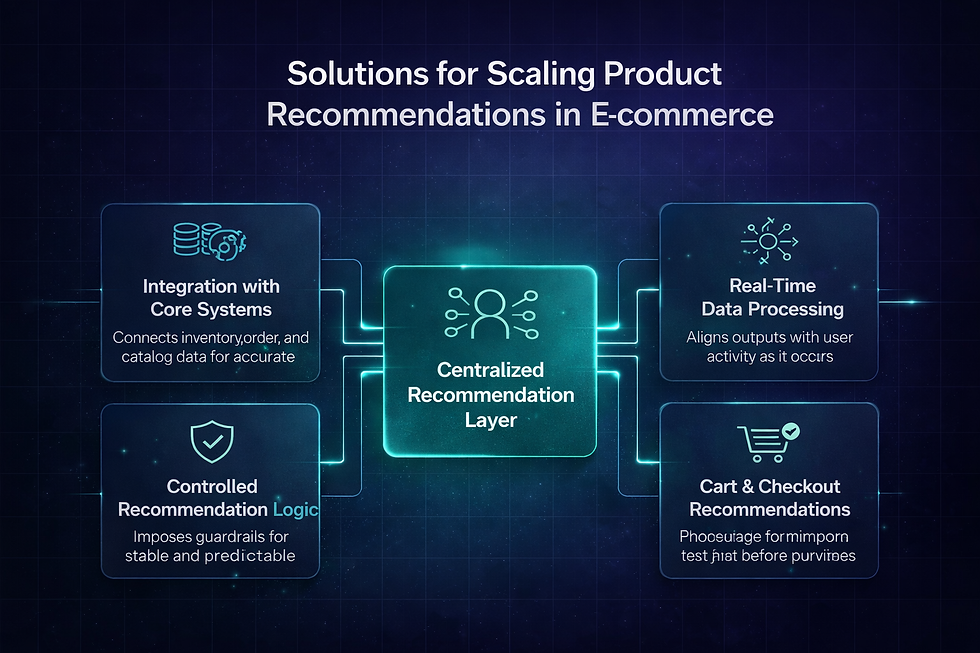
Scaling product recommendations requires integrating them into the commerce architecture rather than treating them as isolated features. This ensures consistency across channels and alignment with system data.
Centralized Recommendation Layer
A centralized recommendation layer processes inputs and distributes outputs across all channels. This prevents conflicting recommendations and ensures consistent behavior.
Integration with Core Systems
Recommendation systems must be connected to inventory, order, and catalog data. This ensures that suggestions are accurate, available, and aligned with product relationships.
Real-Time Data Processing
Recommendations must respond to session activity as it occurs. Event-driven inputs and continuous processing keep outputs aligned with user behavior and reduce delay between input and response.
Controlled Recommendation Logic
Guardrails and monitoring ensure stable outputs. This allows the system to remain responsive while maintaining predictable behavior.
Conclusion
Average order value is shaped by how systems guide product selection during a session. Product recommendations influence what gets added, upgraded, or combined before checkout, and their effectiveness is defined by how accurately they respond to real-time behavior and inventory conditions. At scale, recommendation systems operate as part of the commerce architecture, connected to data flows, catalog logic, and multi-channel execution.
Partnering with Trika Technologies allows retailers to implement product recommendations as a unified system layer, where data integration, recommendation logic, and channel execution operate together and remain aligned with live behavior, inventory, and transaction flow.FAQs
Frequently Asked Questions
1. Can product recommendations increase AOV without increasing traffic?
Yes. Product recommendations increase the value of each session by influencing what customers add to their orders.
2. How much can product recommendations increase average order value?
Effective recommendation systems can increase average order value by 10–30%, depending on category, placement, and data accuracy.
3. Do product recommendations work for all e-commerce categories?
Yes, but impact varies based on how products can be grouped, substituted, or combined within a category.
4. Are rule-based recommendations or AI-driven recommendations more effective?
Rule-based systems are effective for structured relationships. AI-driven systems perform better when handling large catalogs and behavioral variation.
5. How do product recommendations impact conversion rate?
Product recommendations guide users toward relevant products and reduce decision effort, which supports conversion and increases order value.


Sewa mesin fotocopy solutions are commonly used in workplaces today. Machines come in various types. Each is suited for certain tasks.