What is an Inventory Management System in E-commerce?
Updated: Apr 15

Table of Contents -
Inventory inaccuracy is one of the most expensive operational problems in e-commerce, and one of the least visible until it produces a customer-facing failure. An order is placed, payment is taken, and only at fulfillment does the system reveal that the stock was not actually available. Or the reverse: inventory sits unused in one location while another cancels orders due to stockouts.
For retailers operating across multiple channels, warehouses, and fulfilment partners, these failures are not exceptions. They are the outcome of systems that cannot maintain accuracy at the speed and complexity of modern commerce. Inventory inaccuracies increase operational costs through overselling, stockouts, and the manual effort required to resolve them.
This guide covers how inventory systems work, where they fail, and what it takes to maintain accuracy across channels at scale.
What Is an Inventory Management System in E-commerce?
An inventory management system (IMS) tracks, allocates, reserves, and updates inventory across channels and fulfillment locations. Its role is to aim to ensure that systems operate on a consistent view of available stock.
In e-commerce environments, this means coordinating inventory across warehouses, stores, and marketplaces. It sits between order capture and fulfilment execution, ensuring that inventory commitments made at checkout align with what fulfilment systems can actually process.
In practice, the IMS functions as a decisioning layer rather than just a tracking system. It determines whether an order can be accepted, reserved, or rejected based on the current system state. When upstream systems provide delayed or inconsistent data, the IMS produces incorrect outcomes even if its internal logic is correct.
Why Inventory Accuracy Is Critical in E-commerce Operations?
Inventory accuracy determines whether orders can be fulfilled as promised. Every availability signal, routing decision, and delivery commitment depends on it.
Stockouts reduce revenue and increase cart abandonment, while overselling leads to cancellations, refunds, and customer friction. In B2B environments, a single discrepancy can impact account-level commitments, especially when orders are large or contract-bound.
Inventory accuracy only holds if reservations, updates, and reconciliation happen within the same operational window across systems. When these processes drift apart, systems appear consistent internally but fail during fulfillment.
A simple way to quantify the impact is:
Lost Revenue = Stockout Rate × Average Order Value × Order Volume
At scale, even a small stockout rate becomes a recurring revenue loss rather than an isolated operational issue.
How Inventory Gets Out of Sync Across Channels?
Inventory desynchronization is a coordination failure across systems with different update cycles, data models, and ownership boundaries.
Common Causes
Marketplace orders that may not instantly update warehouse systems
Manual inventory processes that introduce delay
Siloed platforms maintain separate inventory states
Returns are not reconciled immediately into available stock
Missing OMS integration, leaving updates dependent on manual intervention
These gaps create a mismatch between what systems believe is available and what can actually be fulfilled.
Commerce platforms such as VTEX and Kibo rely on event queues and rate-limited APIs to process inventory updates. Under normal conditions, updates propagate fast enough to maintain consistency. Under peak demand, event backlogs delay updates, creating temporary windows where inventory diverges across systems.
These issues are not random. They occur predictably when throughput exceeds processing capacity, particularly during promotions, flash sales, or high-volume B2B ordering.
Key Functions of an Inventory Management System

An IMS governs how inventory is committed, reserved, and updated under concurrency. Its role is not just tracking inventory, but preventing conflicting decisions when multiple systems act on the same stock.
Core System Responsibilities
It maintains a consistent inventory view across locations and coordinates updates from OMS, WMS, ERP, and commerce platforms. It applies allocation and reservation logic to ensure inventory is not double-committed, while handling backorders, returns, and replenishment signals.
Reservation Logic and Concurrency Control
Reservation is the critical control point. Inventory must be committed at order confirmation using atomic or idempotent operations that prevent the same unit from being reserved twice.
Without this, concurrent checkouts or multi-channel demand create race conditions where inventory appears available to multiple systems at once.
Latency Window Alignment
These functions only hold if reservations and updates occur within the same latency window. If updates lag behind reservations, systems temporarily diverge, and inventory appears available at checkout but fails at fulfillment.
Failure Pattern at Scale
As volume increases, multiple systems attempt to reserve the same SKU at the same time. Without coordinated control, the system shifts from preventing conflicts to resolving them after they occur, leading to overselling and cancellations.
How to Build a Scalable Inventory Management System?
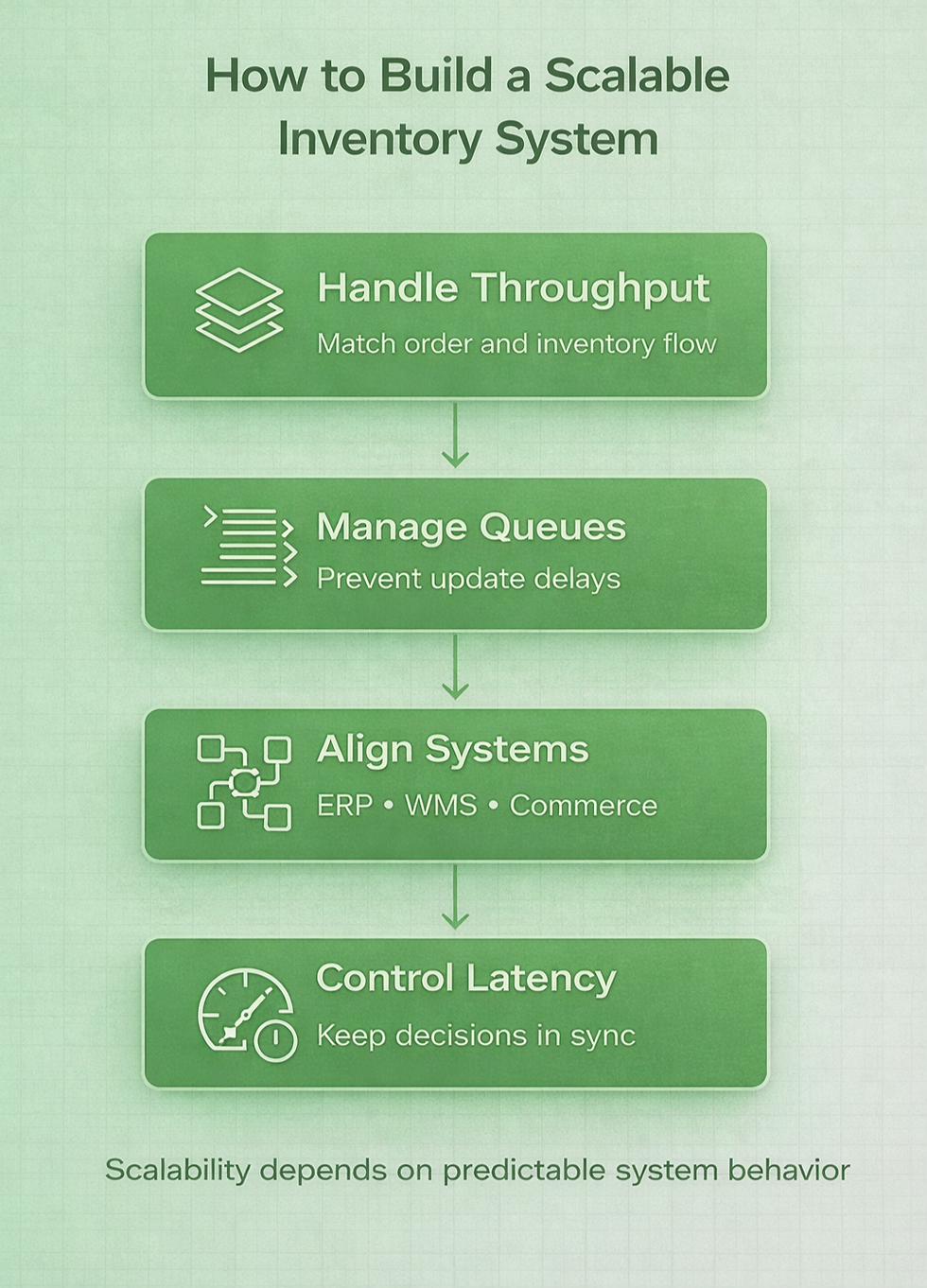
Scalability in inventory systems is not determined by the platform, but by how well the integration layer handles concurrency, latency, and system boundaries.
Platforms such as VTEX and Kibo operate within defined processing limits, using event queues and rate-limited APIs to manage inventory updates. At low volumes, these constraints are invisible. As order volume increases, they become the primary bottleneck.
Without an integration layer that accounts for these limits, systems do not scale linearly. They degrade as throughput increases.
System Constraints at Scale
Inventory systems do not fail because they cannot process data. They fail because they cannot keep decisions and updates aligned under load.
Three patterns define this behaviour:
Throughput mismatch: Order intake scales faster than inventory updates, creating a lag between reservation and stock state
Queue saturation: Event queues accumulate faster than they can be processed, delaying inventory propagation across systems
Multi-system divergence: ERP, WMS, and commerce platforms update at different speeds, creating inconsistent views of inventory
These constraints are not edge cases. They appear predictably when transaction volume exceeds system processing capacity.
Predictable Latency as a Scaling Requirement
Scalability depends on maintaining predictable latency between systems, not just processing more transactions.
As systems scale, the goal is not real-time updates in isolation, but ensuring that reservation, update, and fulfilment decisions operate within a controlled latency window.
When latency becomes inconsistent, systems appear accurate in snapshots but behave unpredictably in real operations. This is where overselling, stockouts, and fulfilment delays increase sharply.
Integration Layer as the Control Point
The integration layer becomes the control point for scalability. It manages how data flows across systems and ensures that platform constraints do not translate into operational failures.
In practice, this includes:
Buffering and sequencing inventory updates to prevent queue overload
Aligning reservation logic across OMS, WMS, and ERP systems
Ensuring that updates propagate within defined latency thresholds
Maintaining a unified inventory view across multiple fulfilment systems
Platforms provide the capability. The integration layer determines whether that capability holds under load.
Implementation Framework
Building a scalable system requires validating behaviour under load, not just confirming system connectivity.
A typical approach includes:
Testing system behaviour under peak order volumes to identify throughput limits
Mapping inventory flows across ERP, OMS, WMS, and commerce platforms
Defining the reservation and allocation logic that accounts for system latency
Ensuring that inventory updates and returns reconciliation occur within the same operational window
Monitoring latency and queue behaviour continuously, not just accuracy metrics
The outcome is not just a system that works, but a system that behaves predictably as volume increases.
How E-commerce Inventory Visibility Works in Real Time?
Real-time visibility means systems operate on an aligned inventory state across OMS, WMS, ERP, and commerce platforms. Updates from picks, reservations, and returns are propagated through APIs, but only within the limits of system latency.
The Slowest System Defines Visibility
Visibility is constrained by the slowest upstream system. If ERP or WMS updates lag, every dependent system operates on outdated inventory, even if others process updates instantly.
2. Where Visibility Breaks
Inventory visibility fails at system boundaries:
ERP or POS silos create fragmented stock views
WMS batch updates introduce timing gaps
Event queue lag delays update propagation under load
These create windows where systems operate on valid but outdated data.
Snapshot Accuracy vs Real Operations
A system can appear accurate in snapshots while failing in execution. Orders are accepted based on one system state, while fulfilment operates on another, creating divergence across channels.
Failure Under Concurrency
These systems work under normal load. Failures appear when concurrency increases, and event queues lag behind order placement.
At that point, updates cannot keep pace with orders, and the gap between system state and fulfillment reality begins to scale.
How E-commerce Inventory Management Works Across Multiple Locations?
Managing inventory across multiple locations requires balancing availability, cost, and fulfilment speed. Unlike single-node systems, decisions are not just about how much inventory exists, but where it should be positioned and how it should be used.
Allocation Logic Across Nodes
Inventory is distributed based on demand patterns, fulfilment roles, and channel requirements. Warehouses, stores, and 3PLs each serve different purposes, and allocation logic determines how much inventory is committed to each node.
Marketplace inventory is often reserved separately to meet availability requirements, while internal channels operate on shared pools. Without clear allocation rules, systems either over-commit or under-utilize inventory across locations.
Trade-offs Between Availability and Efficiency
Every allocation decision introduces trade-offs. Concentrating inventory in fewer nodes improves operational efficiency but increases delivery time and stockout risk in other regions. Distributing inventory improves availability and delivery speed but raises fulfilment and holding costs.
These trade-offs shift with demand patterns, seasonality, and channel mix, requiring systems to adapt continuously.
Dynamic Rebalancing and Demand Signals
Effective systems continuously rebalance inventory across nodes based on demand signals rather than relying on static allocation. This includes repositioning stock, redirecting fulfilment flows, and adjusting reservation priorities in near real time. Without dynamic rebalancing, inventory pools drift out of alignment with demand, leading to excess stock in low-demand nodes and shortages in high-demand locations.
Common Inventory Management System Challenges
Most failures come from integration gaps rather than system limitations.
Common Failure Points
API rate limits are causing update delays
Data mapping mismatches between systems
Legacy ERP systems running on batch cycles
Missing returns loops are delaying stock reconciliation
These issues are often invisible during testing and emerge under peak load. Systems behave correctly in isolation but produce incorrect outcomes when combined due to timing differences and inconsistent assumptions.
Where Inventory Systems Break Without Proper Integration?
Inventory systems rarely fail because of missing features. They fail when integration layers cannot keep systems aligned at the pace of decision-making.
Order Acceptance vs Inventory State Mismatch
The most common failure pattern appears during order placement. An order is accepted based on the inventory state exposed by the commerce platform, but that state is already out of sync with the actual system of record. The reservation happens immediately, while the stock update propagates with a delay through APIs or event queues. In that gap, the same inventory can be committed multiple times across channels. This is not a data accuracy problem. It is a timing problem between systems that are technically correct but not synchronized.
Event Queue Lag Under Peak Load
A second failure pattern appears under peak load. As order volume increases, event queues begin to lag, and API throughput becomes constrained.Inventory updates that normally propagate in milliseconds now take seconds or minutes. During that window, order acceptance continues at full speed while inventory state updates fall behind, widening the gap between availability and fulfilment reality.This is where most overselling issues surface, even in systems that appear stable under normal conditions.
Batch Updates vs Real-Time Decisions
Batch-based systems introduce a different kind of failure. When ERP or warehouse systems update inventory in intervals rather than continuously, every batch cycle creates a temporary divergence between systems. Orders placed during that interval operate on stale data. The system behaves correctly within its own update cycle, but incorrectly in the context of real-time order flow.
Returns and Inventory Drift Over Time
Returns create a slower but persistent failure mode. When returned inventory is not reintroduced into available stock within the same operational window, discrepancies accumulate gradually. The system appears stable in the short term but drifts over time, especially across multiple locations. This often goes unnoticed until reconciliation gaps become operational issues.
Failure at System Boundaries
These issues rarely appear during testing because systems are evaluated under normal load. They emerge only when concurrency, latency, and system boundaries interact.
Each system behaves correctly in isolation, but the combined system produces incorrect outcomes because timing, ownership, and update flows are not aligned.
Conclusion
Inventory accuracy in e-commerce depends on how well systems stay aligned under real operating conditions. Tracking stock is only one part of the problem. The real challenge lies in keeping reservations, updates, and fulfilment decisions synchronized across OMS, WMS, ERP, and commerce platforms as order volume increases. Most failures appear when systems operate at scale. Latency gaps, queue backlogs, and mismatched update cycles create conditions where inventory looks accurate in one system but fails during fulfilment. These are predictable outcomes of systems that are not designed to handle concurrency and coordination across multiple channels.
A scalable inventory management system maintains a consistent view of stock while ensuring that every reservation and update happens within a controlled operational window. This requires an integration layer that manages how systems interact, not just how they connect. Trika Technologies works with retailers to build and optimize these integration layers, ensuring inventory, order management, and fulfilment systems remain aligned as complexity increases. When systems operate with predictable latency and coordinated decision-making, retailers reduce cancellations, improve fulfilment reliability, and maintain consistency across channels.
Frequently Asked Questions
Q1. How do inventory systems keep stock levels synchronized across multiple sales channels?
Inventory systems use event-driven APIs to update stock across channels when sales, returns, or movements occur. Middleware ensures consistency between systems.
Q2. What role do APIs play in modern e-commerce inventory management?
APIs enable near real-time data exchange between IMS, WMS, ERP, and commerce platforms, ensuring updates reflect across systems without manual intervention.
Q3. How do retailers prevent inventory conflicts when multiple orders occur simultaneously?
Atomic reservation logic helps prevent the same unit from being allocated to multiple orders under concurrent demand.
Q4. What operational metrics indicate that an inventory management system is performing effectively?
Key metrics include inventory accuracy, fulfilment exception rate, stockout frequency, and returns reconciliation speed.
Q5. How do e-commerce platforms handle inventory updates during high-volume sales events?
Systems use event queues, buffered updates, and validated integration capacity to maintain consistency under peak load.


Comments